
 Українська (Україна)
  Русский (Россия)
  English (United Kingdom)
 RGB Staircase Lighting with Analog LED Strips or Lamps.
Introduction.
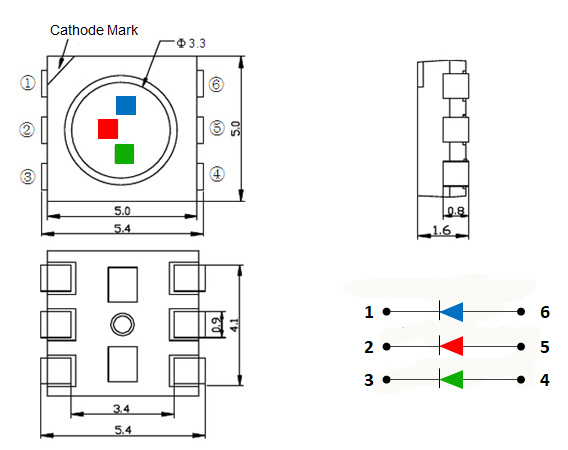
In this part, we will consider how to create a staircase backlight using conventional analog LED strips or lamps. First, let's look at a little theory about what an RGB LED is, how it is controlled and how it is connected.
An RGB LED consists of three crystals combined in one housing. Red - A, Green - Green, Blue - A, which is defined in the abbreviation "RGB" / In fact, these are 3 separate LEDs with cathodes (-) or anodes (+) connected together, and the second contact is brought out to connect the control controller. The second contact can be connected either to the corresponding color channel of the control controller, or directly to the power source. That is, in fact, the mime can be controlled even manually by connecting the corresponding channel. As is clear from the name, the LED itself has 3 primary colors, but by turning on several channels at the same time and changing their brightness, you can get a full color spectrum of up to 16 million colors. In the figure below, we will consider an example of a section of RGB LED strip.
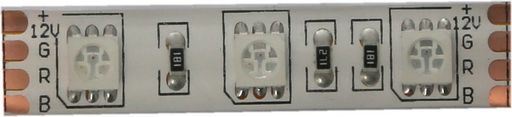
As we discussed in the first part, about monochrome LED strip, RGB strips also come with a supply voltage of 12V and 24, where 3 or 6 LEDs are connected in series in each segment and ballast resistors are installed for each color channel. This is similar to the monochrome strip, it allows you to reduce the current by increasing the supply voltage of the LED strip, respectively, use thinner wires and connect more LEDs to one channel of the controller while observing the current limitations. Read more at the link.
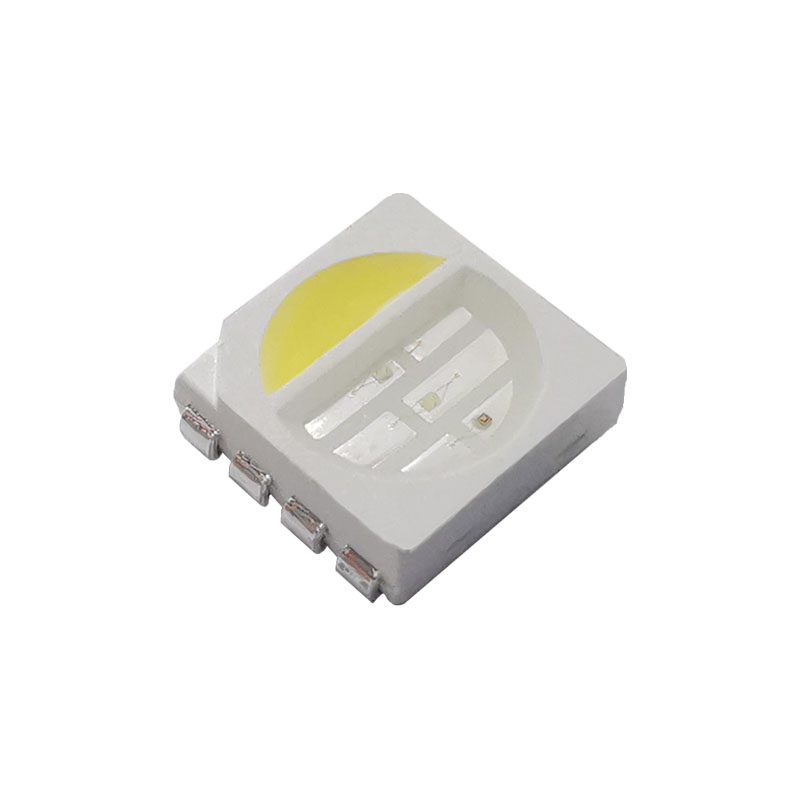
Analog LED strips usually have a common anode (+) and separate cathode contacts (-) for each color. There are also 4-crystal analog RGBW LED strips that have an additional channel of white or warm-white crystal, these LED strips already have a 5-wire connection. and we will not consider them, although their use is also quite possible and justified.
How to use analog RGB LED strip for automatic staircase lighting.
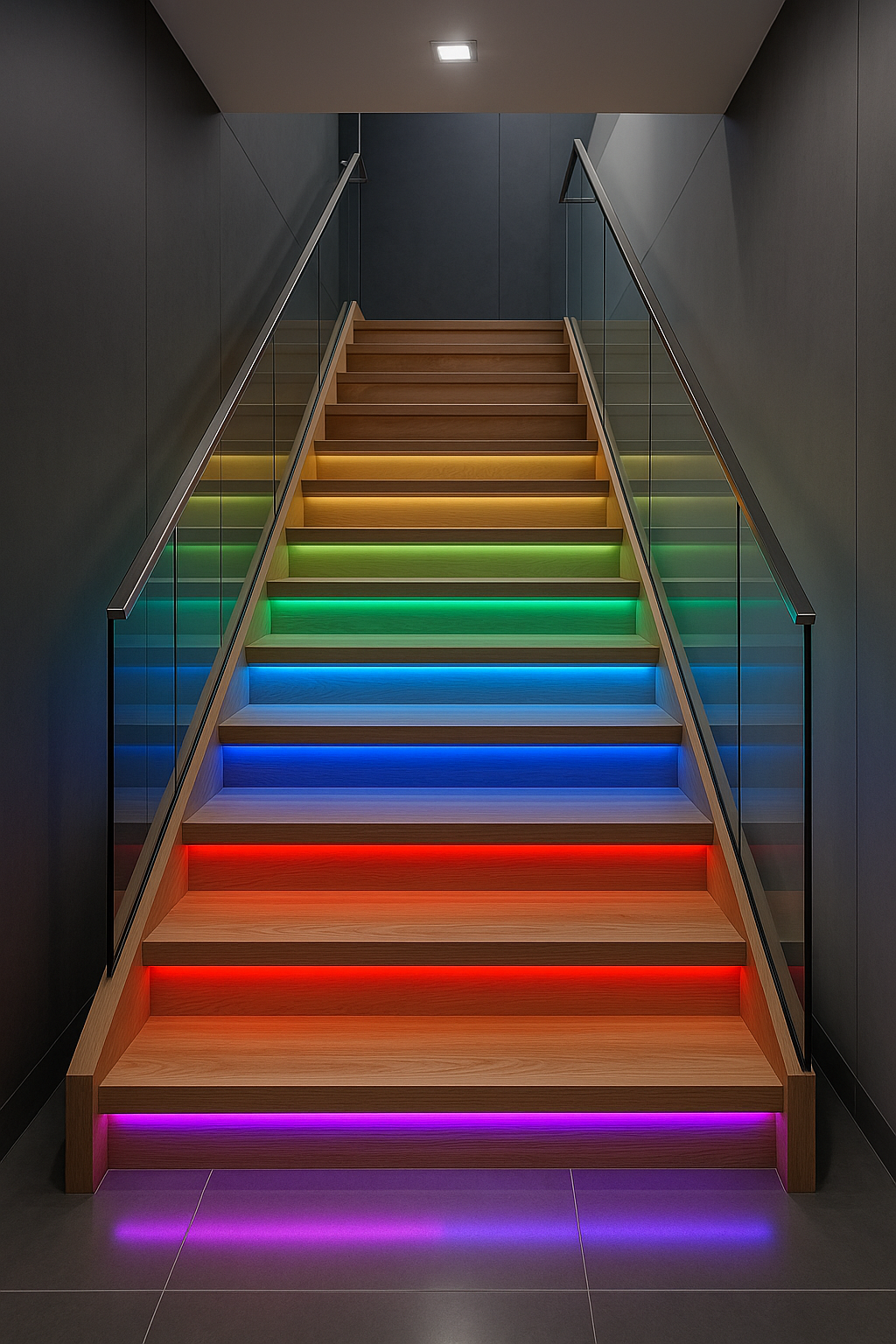
Some of our customers, guided by the properties described earlier, simply connect RGB LED strips to our controllers for monochrome staircase lighting of the SmartStairway SS-26 series, using one or more color channels for connection. In this case, they implement single-color illumination of all steps or different, but static colors for each step, using different color channels or their combination for different steps. In this case, you can implement static color illumination without any additional devices. As a result, you can get something similar to what is shown in the pictures below:
Calculation of LED strips by power and current.
Each RGB LED actually consists of 3 LEDs, so when calculating the power, you should take into account the number of LEDs, supply voltage and the declared power parameters. For example, an RGB SMD5050 LED strip, A 12V, 60 A / M with a power of 14.4 W / m for each color will have only 30% of the declared power in the maximum brightness mode (averaged, in fact, the red channel is less, and the green is more) and only in white mode, when all 3 channels are turned on at maximum brightness, this LED strip will consume 14.4 W / m. Accordingly, 14.4 W / m at a voltage of 12 V corresponds to a current of 1.2 A / m (14.4/12=1.2A) this is true for white. If you want to use only 1 color channel, then the current strength can be taken as 0.4A, if 2 channels, 0.8A respectively. Thus, you should multiply the length of the LED strip by the current strength and you will get the total current strength to calculate the required power of the power source. For more details, see point 2 in the first part of the article.
Choosing equipment for RGB backlighting of stair steps.
If you still want to create a full-fledged RGB LED backlight that can be controlled and change color and have dynamic modes, we have developed an additional amplifier module with a built-in RGB controller that has an infrared remote control and allows you to select not only static colors for all steps, but also use dynamic modes. Today we produce 2 models amplifiers:
- SmartStairway A21 RGB 4-12 - allows you to connect up to 21 channels using RGB LED strips DC 12V with a current of up to 4A per channel.
- SmartStaitway APS21 RGB 10-24 - allows you to connect up to 21 channels using RGB LED strips DC 12V/24V with a current of up to 10A per channel.
Of course, to create colored RGB backlighting (lighting) of your LED staircase, you will need a controller for the Smart Stairway SS-26 series staircase.
You can choose the SmartStairway SS-26 controller - If your staircase has limited inputs, i.e. there is a wall on both sides or transparent railings for the infrared beam (silicate glass does not transmit IR rays and can be considered opaque, and openwork railings perfectly transmit IR rays and are almost transparent for pyroelectric sensors).
If there are no railings, they are transparent and there is no way to use a pyroelectric sensor, then it is better to choose the Smart Stairway SS-26 controller, since it has a display and is convenient for using ultrasonic sensors and supports infrared rangefinders.
We discussed in detail how to choose sensors in the first part in section 3.
Since we will use an amplifier, the controller output power does not matter and it is quite enough to control the amplifier. Therefore, when calculating and selecting LED strips, we will focus on the channel power of the selected amplifier. Most RGB LED strips are based on SMD5050 LEDs (SMD means surface mount, and 5050 means that the case size is 5x5 mm) and have a supply voltage of 12 V with a segment of 3 series-connected LEDs. Less common are 24 V LED strips with segments of 6 series-connected LEDs. LED strips usually have a standard density of 30 LEDs per meter with a power of 7.2 W / m and a double density of 60 LEDs per meter with a power of 14.4 W / m. Now there are also denser LED strips and strips built on many small LEDs with a monolithic coating, called COB. Knowing the power and supply voltage of the LED strip, you can always calculate the current for one step using Ohm's law:
P = U * I or I = P / U
where :
P - power, W.
U- supply voltage, V
I- Current, A
A detailed review of the amplifier for automatic RGB lighting of stair steps is shown in the video review of the SmartStairway APS-21 amplifier.
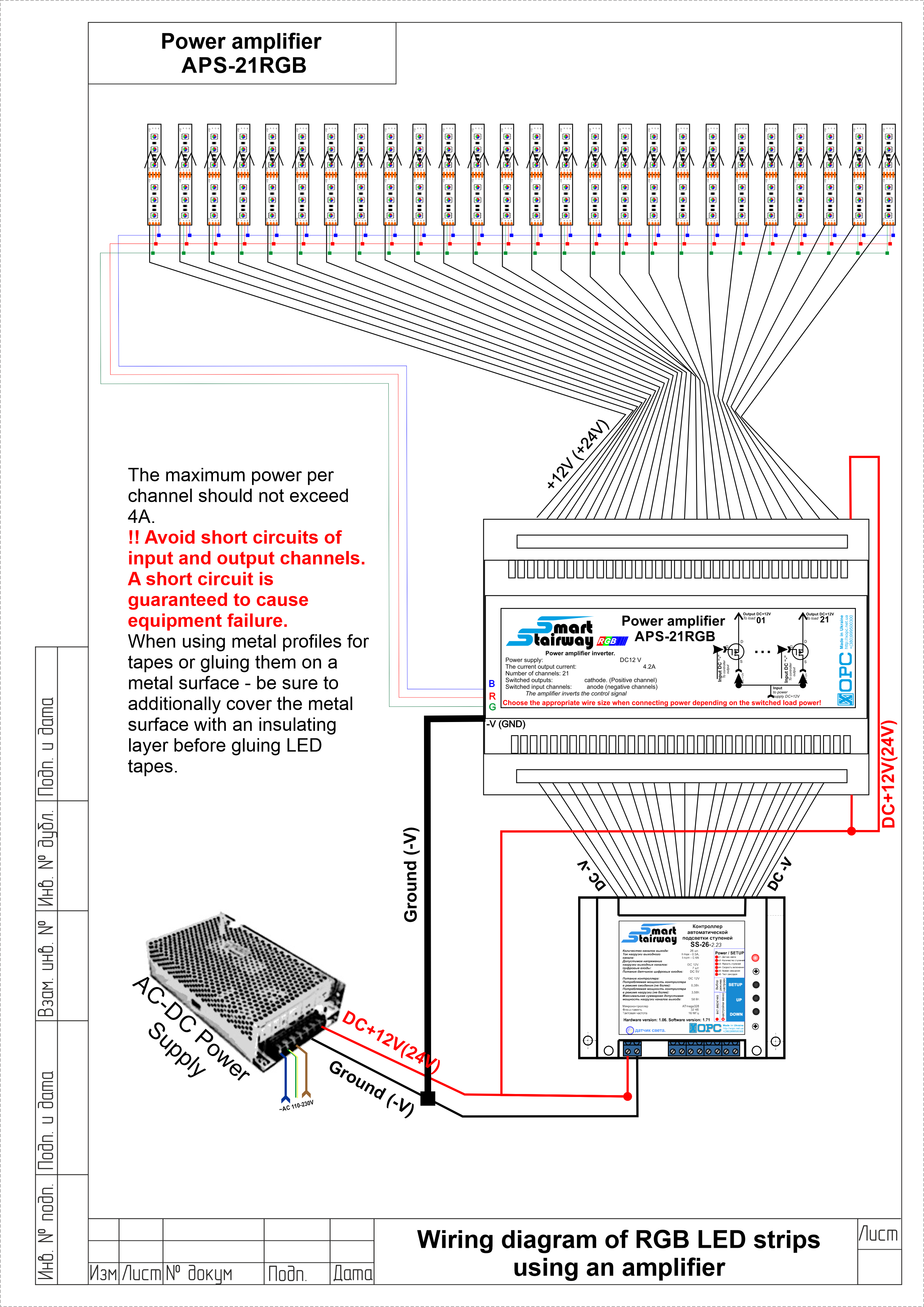
The amplifier-inverter has 21 independent channels to which the anode (+) of the LED strips is connected, which control the smooth switching on and off of the channelsin, also the amplifier has three cathode channels (-) for color control of all LED strips. This connection scheme allows to significantly reduce the number of wires that will have to be laid to the steps. That is, you can lay 3 buses for all steps of the stairs, to which the cathodes of the RGB color channels are connected, and to the amplifier extend only 1 wire (+) from each step, which will control the switching on and off of the steps of the stairs.
The diagram below shows the connection diagram of RGB LED strips for automatic lighting of the stairs.
Calculation and selection of wire cross-section area (caliber).
When laying common buses for color channels, do not forget to calculate and correctly select the wire cross-section.
To calculate the cross-sectional area of the wire with a voltage drop of no more than 5%, use the formula:
S = (2 * I * L * ρ) / ΔU
Where:
- S — cross-sectional area (mm²),
- I — current (A),
- L — wire length (20 m),
- ρ — copper resistivity (0.0175 Ohm mm²/m),
- ΔU — permissible voltage drop (5%).
Copper cross-sectional area calculator wires
ρ (copper) = 0.0175 Ohm mm²/m
Calculation example:
Let's say you have 17 steps of 1 meter each and the maximum length of the wire from the farthest step to the amplifier is 10 m. You are using a DC 12V, SMD5050, 60 LED strip LED/m with a power of 14.4 W/m. The current strength may not be specified by the manufacturer, so we will calculate it by dividing the power by the supply voltage. We get 14.4 (W/m) / 12 (V) = 1.2 (A/m). Multiply 17 steps by 1.2 A and get the total current for all steps in white mode for all three color channels turned on in maximum brightness mode: 17 * 1.2 (A) = 20.4 (A). Since we have three buses for color control and each of them is approximately 1/3 of the total current, we find out the current strength per 1 color channel by dividing the resulting value by 3: 20.4 (A) / 3 = 6.8 (A) per 1 color channel. Substitute the value into the calculator above and get a value of 3.97 mm. square. Accordingly, we will select a wire with a cross-sectional area of 4 mm2 for the power bus.
Similarly, you can calculate the cross-sectional area for each step. Since the common anode wire (+) of the LED step will pass through itself the current of all three color channels, then for the calculation we take the total current for the LED strip of one step. In the example considered above for a step 1 meter long with a tape DC 12V, SMD5050, 60 LED/m with a power of 14.4 W/m. and a current of 1.2 A/m with a wire length to the farthest step, you will need a wire with a cross-sectional area of 0.7 mm2.
We will answer the question right away: What will happen if the cross-sectional area of the wires is smaller or the wire material is not copper, but, for example, bimetal (copper-plated alloy)? Everything is very simple, in the best case, when changing the parameter ρ - the specific resistance of copper (0.0175 Ohm mm²/m), the voltage drop delta for the farthest step will be more than 5 percent and, as a result, the brightness for each of the color channels will decrease, and since red has the lowest voltage, the color gamut of the farthest step will be shifted to red. That is, the most distant step in the business color mode will be pink and similarly, all other colors using a red crystal will be distorted towards red in the spectrum. In the worst case, too thin wires can heat up a lot, cause insulation melting and even cause a fire. Pay special attention to this parameter, since your safety depends on the accuracy of your calculations and choice!
Calculation and selection of a power supply.
Similarly to the method of monochrome illumination of stair steps, described in the first part, a power supply is selected for RGB lighting of stairs. The algorithm has not changed. You need to add up the power of all LED strips, add 20% of the power reserve and select the nearest larger power supply from the range. That is, for the example we considered earlier of calculating the lighting for a staircase with 17 steps, we will need a power source of 12V, 20.4A + 20% = 24.48 A or 24.48 (A) * 12 (V) = 293.76 (W), i.e. we can choose the closest available power300W or more. You can use a convenient calculator at link.
Selection of sensors and wires for them.
The process of selecting the type of sensors and their installation location is described in great detail in the calculator for calculating LED stair lighting and the first part of the article. Please follow the links below:
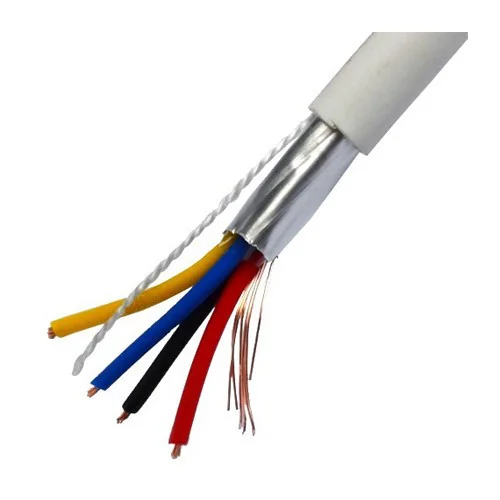
As for the wiring, it is always preferable for any type of sensors to use a shielded signal wire, the shield of which is grounded or at least connected to the ground of the power source. This will avoid inductive interference and interference in the signal wires of the sensors. But if you already have an unshielded wire, it is better to use IR rangefinders E18-D80NK, since they have a high signal in the wire in the standby state, which makes them insensitive to inductive interference. Together with them it is better to use the controller SmartStairway SS-26 LCD PRO V4, which has protection against overvoltage of digital inputs and is able to compensate for long-term overvoltages up to 30V and short-term static discharges up to 1000V.
Using RGB lamps for lighting stairs.
Like LED strips, LED RGB lamps have the same connection principle, power and circuit. Accordingly, all the information given above for LED strips is also true for analog RGB lamps. Accordingly, we are talking about lamps without a built-in RGB controller. If the lamp already has a built-in controller, then such lamps will not suit you, since you will not be able to synchronize their control and the color palettes will be unpredictable. Therefore, use RGB 12 or 24V lamps with 4 wires for connection, with a standard RGB circuit (+, R, G, B) and supporting dimming.